
IBQ-MEC-526: Protection and mobility in motorcycle clothing
In the development of a fabric for motorcycle clothing, Abrasion resistance is essential. But it cannot be achieved at the expense of mobility.
A rider constantly changes position on the motorcycle. The back flexes, the arms work, the knees shift, and certain areas of the garment are under continuous tension. Added to this is the incorporation of increasingly advanced protection systems, such as integrated airbags, which need space to deploy correctly.
The challenge, therefore, is to make a garment that can protect, support movement and adapt to the body at the same time.
IBQ-MEC-526 was created precisely to respond to this need.
Not all areas of a motorcycle garment work the same.
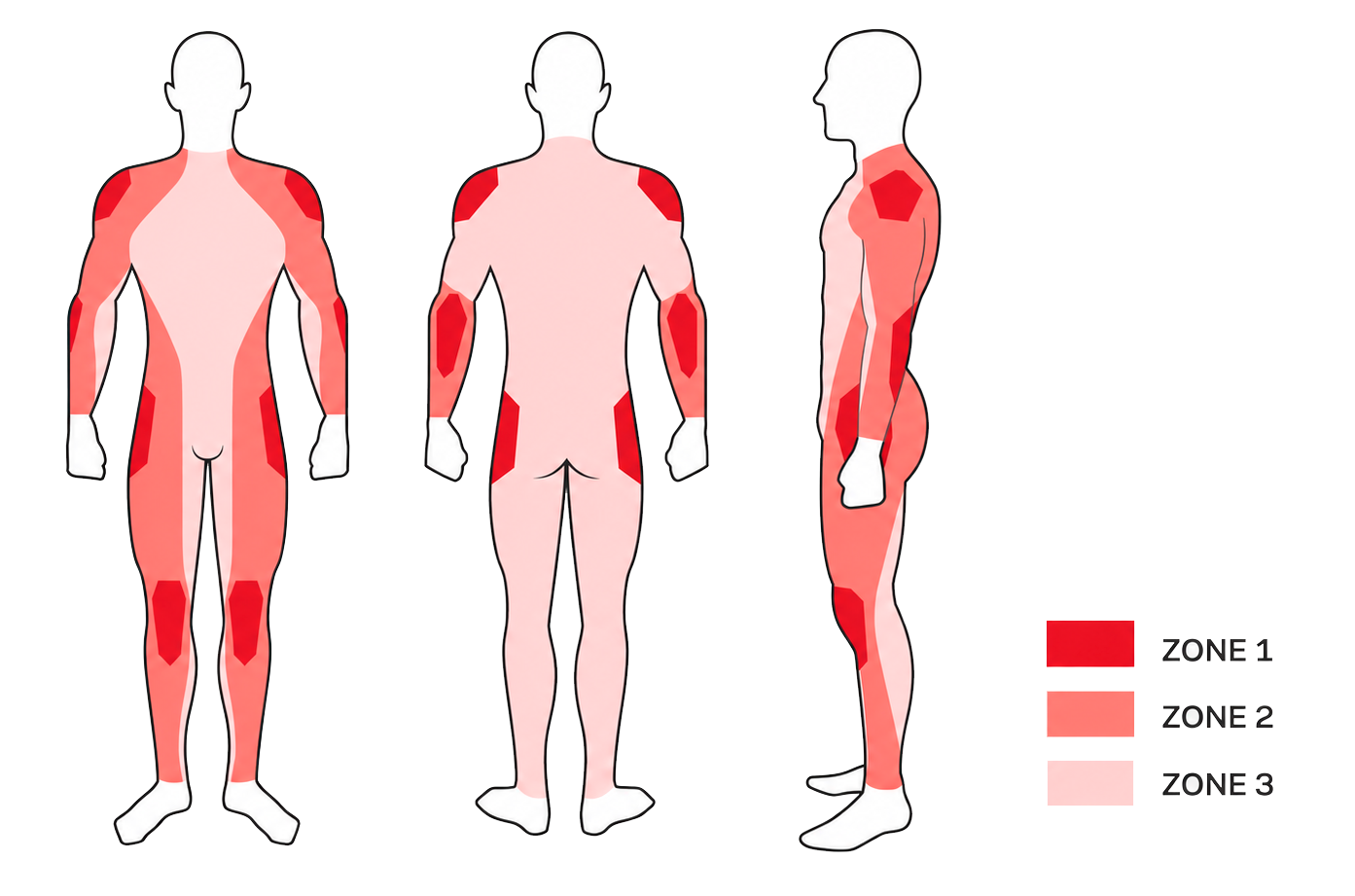
Protective gear for motorcyclists is subject to very different demands depending on the area of the body.
During a fall, shoulders, elbows, hips, and knees are among the areas most likely to make contact with the asphalt. Other areas present a lower risk, but must maintain the garment's structural integrity and allow freedom of movement while riding.
The standard UNE EN ISO 17092, specifically for protective clothing intended for motorcyclists, takes this reality into account through a classification of the different risk zones of the garment.
The Zone 1 Zone 1 corresponds to the areas of greatest exposure, while zones 2 and 3 have progressively different requirements depending on the level of risk.
This logic allows garments to be designed strategically: concentrating the highest performance where it is really needed and using materials capable of providing other functions — such as elasticity or comfort — in the areas that must accompany movement.
The challenge: protecting a body that is always in motion
A motorcycle garment does not remain static.
During driving, the driver continually changes posture: leaning into curves, shifting body weight, flexing arms and legs, and adopting very different positions depending on the type of driving.
In competition, these demands are even greater.
But even in touring or sporty road riding, certain areas of the garment are continuously subjected to bending, stretching, and mechanical stress.
Traditionally, leather has been a benchmark material due to its abrasion resistance. However, its expansion capacity is limited.
For this reason, manufacturers have used so-called accordion-style leather panels.
Accordion panels: an effective solution, but with limitations
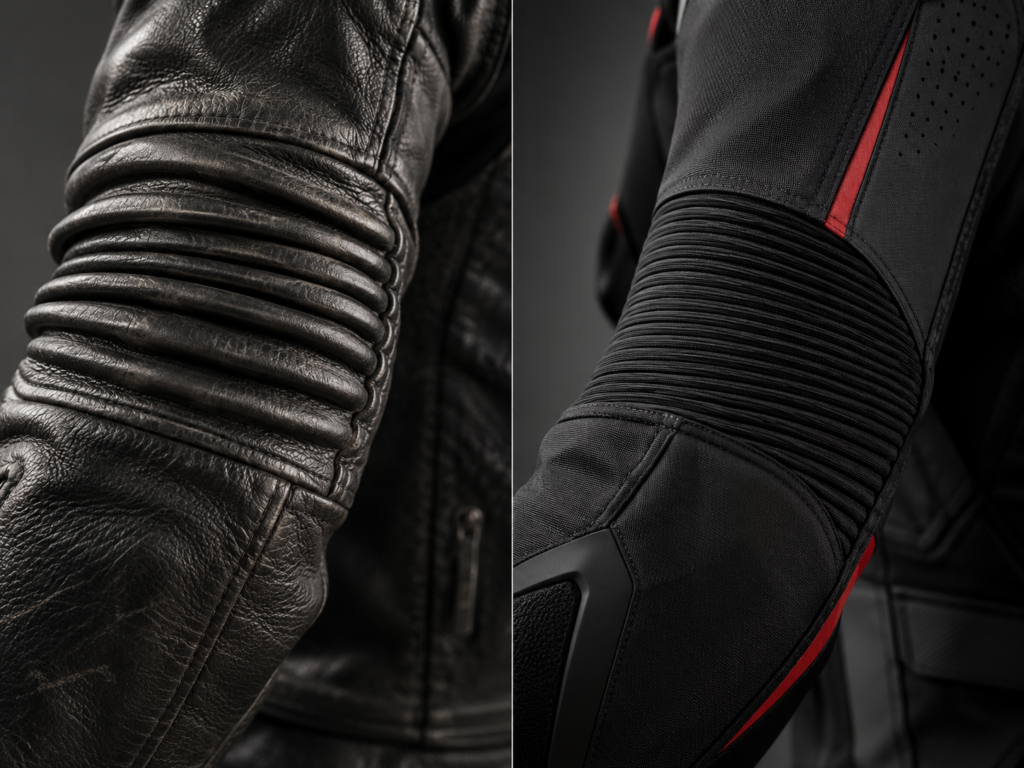
Accordion panels are created by folding leather into different sections that are joined together using elastic stitching.
When the pilot is in a neutral position, the pleats remain compressed. When greater freedom of movement is needed, the panel opens, providing the necessary additional volume.
This solution works, but it also introduces some drawbacks.
Manufacturing these panels requires more leather than a flat construction and adds several layers of material to the same area. As a result, the following may increase:
- the weight of the garment;
- the thickness of the panel;
- the complexity of manufacturing;
- material consumption;
- and the perceived temperature in certain areas.
In disciplines where every gram can influence pilot fatigue and where comfort plays an important role in concentration, these limitations have driven the search for new textile solutions.
The question is simple:
Can expansion, strength, and mobility be achieved with a more efficient textile construction?
IBQ-MEC-526: a textile solution for expansion and reinforcement
IBQ-MEC-526 has been developed as a technical fabric for expansion panels and reinforcement zones in motorcycle garments.
Its construction 450 g/m² double weave twill It combines a high mechanical resistance outer face with a more comfortable cotton reverse.
This architecture allows each side of the fabric to have a specific function.
The outer layer is designed to provide resistance against abrasion, tearing, and snagging. The inner layer improves comfort when the fabric is in direct contact with the wearer.
The result is a material designed for areas where the garment needs to match. durability and movement, without turning elasticity into a weak point within the construction.
Four fibers. One single system.
The behavior of IBQ-MEC-526 is based on the combination of four components:
32 % cotton
It provides comfort and helps improve the feel of the fabric in contact with the user.
30 % PA Cordura®
It enhances abrasion resistance in applications subject to high wear.
28 % polyamide
It contributes to the mechanical strength and durability of the structure.
10 % elastane
It provides bidirectional elasticity, mobility, and recovery after stretching.
It's not just about achieving an elastic fabric.
The goal is to control how the material deforms and how it subsequently recovers its shape.
97 % recovery to accompany the movement
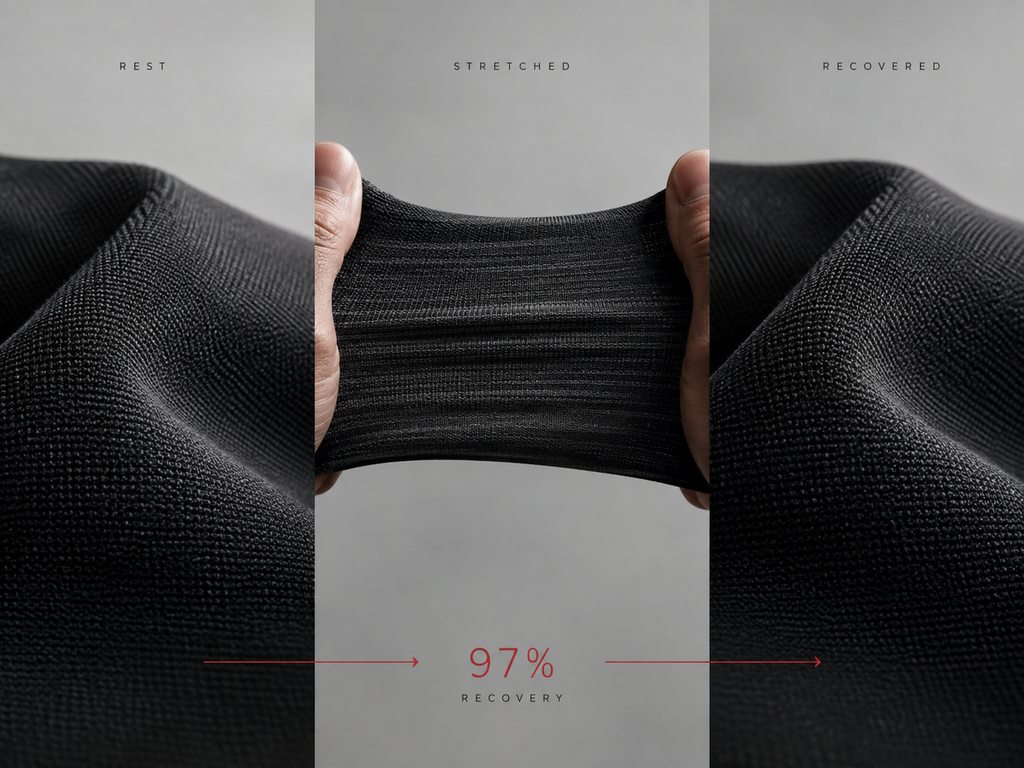
IBQ-MEC-526 achieves a 97 % recovery according to EN ISO 20932-1.
This property is especially relevant in garments that are repeatedly subjected to stretching cycles.
The fabric can move with the rider and then return to its original shape, helping to maintain the fit and functionality of the garment throughout use.
In motorcycling, this capability allows the development of panels that provide volume when needed without permanently maintaining an oversized structure.
Resistance where it really matters
Flexibility does not mean giving up on resilience.
IBQ-MEC-526 has been designed precisely to combine both features.
In Martindale abrasion tests, the fabric exceeds the 250,000 cycles, compared to the 100,000 cycles of the generic bi-stretch fabric used as a comparative reference in the product's One Pager.
It also offers high mechanical resistance values:
Tear resistance according to EN ISO 13937-2
- until 110 N in warp;
- until 200 N in weft.
Tensile strength according to UNE-EN ISO 13934-1
- until 1,450 N in warp;
- until 1,500 N in frame.
These features allow the fabric to be used in areas subjected to repetitive stress without resorting exclusively to rigid or excessively heavy constructions.
AAA Zone 2 abrasion performance according to EN 17092
IBQ-MEC-526 presents AAA Zone 2 abrasion performance according to EN 17092, evaluated by OMEGA.
This distinction is important.
The UNE EN ISO 17092 standard certifies the full garment, not a fabric in isolation. The certification process collectively evaluates materials, seams, closures, construction, pockets for protectors, and other structural elements.
Therefore, IBQ-MEC-526 should not be understood as a “AAA certified” garment, but as a fabric that has demonstrated abrasion performance corresponding to AAA Zone 2 within the testing framework defined by the standard.
For manufacturers, this type of information allows them to select technically suitable materials to develop garments geared towards specific levels of protection.
A new way to build expansion panels
One of the most interesting applications of IBQ-MEC-526 is found in the expansion panels.
These panels can be strategically placed in those areas of a jacket, pants or jumpsuit where the body needs greater freedom of movement.
For example, in the lumbar region, A flexible panel can allow the garment to adapt to the rider's changing posture when they adopt a more aggressive position on the motorcycle.
Instead of achieving this expansion through multiple folds of leather, an elastic textile construction allows the deformation to be generated directly through the structure of the fabric itself.
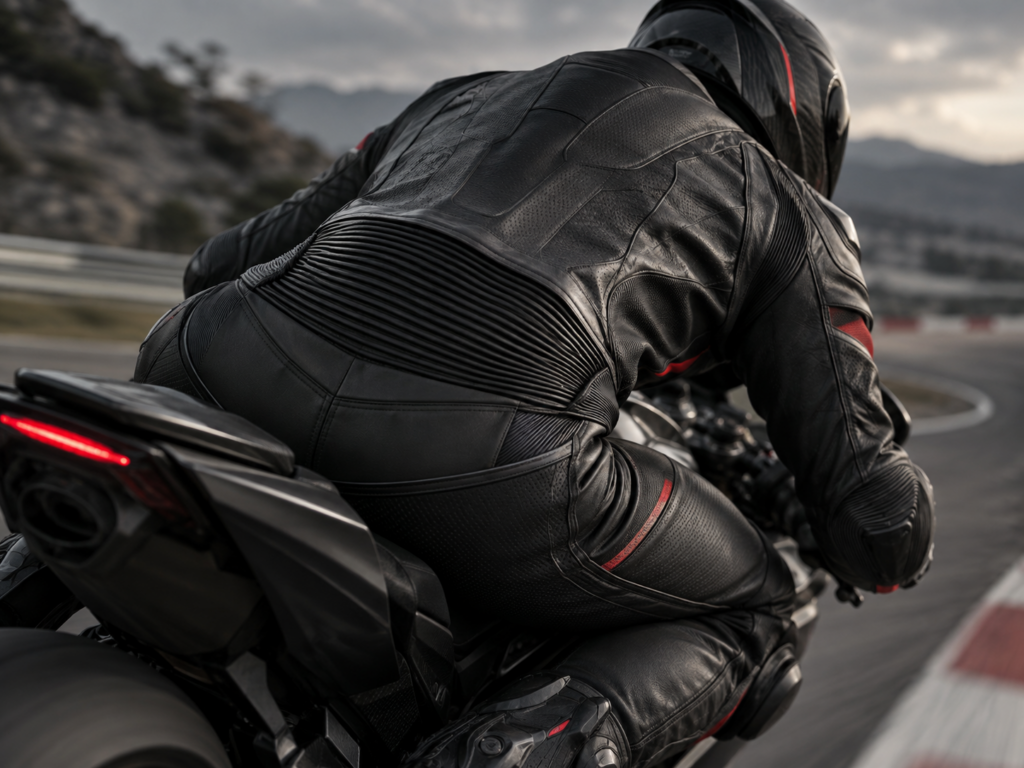
This can help reduce volume, thickness and leather consumption compared to certain traditional constructions.
When the airbag changes the rules
The integration of airbag systems has added a new variable to the design of motorcycle clothing.
During deployment, the airbag needs to expand in a matter of moments. The garment must have sufficient capacity to accommodate this increase in volume without impeding the system's operation.
Therefore, an expansion zone should no longer respond solely to the normal movement of the pilot.
It may also need to provide the necessary flexibility to allow for the expansion of integrated protection systems.
IBQ-MEC-526 provides a combination of Controlled elasticity, recovery, and mechanical resistance geared towards these types of applications. Its Tech Insight highlights its use in expansion panels for motorcycle garments and constructions associated with airbag systems.
Protection and mobility should not be opposing concepts
For years, increasing the protection of a garment often meant adding material.
More layers.
Thicker.
More weight.
But textile engineering allows us to approach the problem from another perspective.
It's not simply about adding protection, but about place the right feature in the right place.
An impact zone needs resistance.
A joint needs mobility.
An expansion panel needs elasticity and recovery.
An airbag system needs space to deploy.
The design of a technical garment begins when all these functions are integrated within the same system.
The result: less volume, more movement
The strategic use of IBQ-MEC-526 allows the development of expansion and reinforcement zones capable of combining:
High abrasion resistance, to support demanding applications.
Bidirectional elasticity, to accompany the pilot's movements.
97 % recovery, to maintain the shape after stretching.
High tear and tensile strength, to respond to mechanical demands.
Double-sided construction, which combines a tough outer face with a more comfortable inner surface.
Lower volume, compared to certain traditional multi-layered leather solutions.
The goal is not to replace all the materials used in a motorcycle garment.
It's about using each material exactly where it can offer its best performance.
Protection that moves with the pilot
A high-performance motorcycle garment is not simply one that achieves the highest abrasion value.
It is one that is capable of integrating protection, mobility, fit and comfort within a coherent construction.
IBQ-MEC-526 represents this way of understanding textile development.
A fabric designed for areas where the material must be durable without hindering movement.
Where elasticity must provide freedom, but also recover its shape.
And where protection must accompany the pilot in every position.
MOVE FREELY. PROTECT COMPLETELY.
Protection that moves with the rider.
Do you develop protective clothing for motorcycling?
Discover how IBQ-MEC-526 It can be integrated into expansion panels, reinforcement zones and new constructions for technical motorcycle garments.
Discover IBQ-MEC-526 and its technical features.
YOU DO. WE PROTECT.